The Case for Contention by Jonathan Zimmerman & Emily Robertson
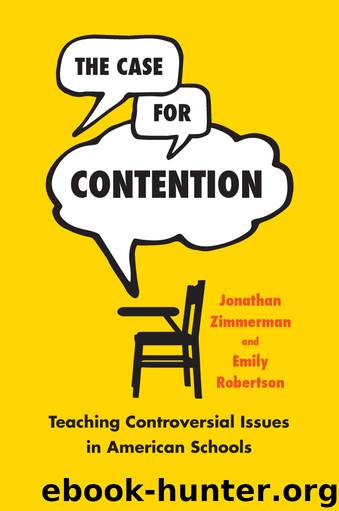
Author:Jonathan Zimmerman & Emily Robertson [Zimmerman, Jonathan]
Language: eng
Format: epub
ISBN: 978-0-226-45648-5
Publisher: University of Chicago Press
Published: 2017-03-30T16:00:00+00:00
How Should Controversial Issues Be Taught? Ethical and Epistemic Issues
If the teaching of controversial issues is to some extent unavoidable or if, as supporters claim, such issues should be taught in schools to develop an overlapping set of intellectual and civic virtues, how should they be taught? Our focus here is not on the best teaching techniques but rather on the moral and intellectual stance teachers should take. The usual response is that they should take a neutral stance toward the competing positions, engaging with all reasonable ones but not directing students toward any one conclusion. For example, the Green Bay [Wisconsin] School District’s Statement of Policy on controversial issues says: “District teachers do not ‘teach’ controversial issues; they teach about such issues. . . . Teachers shall not attempt to limit or control the judgment of students on controversial issues. . . . They should insist on understanding but not agreement on controversial issues.”50 The Hawaii Board of Education Policy for teachers when they are addressing “issues which generate opposing points of view” states: “Teachers shall refer students to resources reflecting all points of view. Discussions, including contributions made by the teacher or resource person, shall be maintained on an objective, factual basis.”51 School boards disagree on whether a neutral stance requires that teachers should not state their own opinions. Many of the boards whose policies we have examined allow this as long as teachers are clear that it is their opinion, they do not push students to share it, and they fairly present the alternatives.52 Some boards require teachers to remain silent about their own views53 or to state their views only in response to a direct question from a student. Why should teachers not aim to “control the judgment of students,” as the Green Bay School District specifies, when teaching controversial issues? Must they make all positions available? Is this always the right stance when considering issues that are controversial in each of the senses we described earlier? School boards typically define a “controversial” issue as one on which the public is divided (there are different opinions) or that arouses local sensitivities (there is emotional investment). Do policies such as Green Bay’s imply that biology teachers must make available information and arguments on intelligent design as well as evolution and claim their preference for evolution as merely “an opinion”?
Before addressing this question, let us recall our earlier account of different ways in which an issue might be controversial, since we have held that different teacher stances may be required for different types of controversies. In formulating these categories we drew on the following criteria for controversial issues: (1) they are the subject of conflict or disagreement; (2) fairly knowledgeable, reasonable people can rightly disagree about which position is correct or best; (3) it’s a “hot-button” issue, that is, there is emotional investment in it; and (4) it’s a matter of public concern. We then noted that different accounts of controversial issues drew on these criteria in different combinations.
Download
This site does not store any files on its server. We only index and link to content provided by other sites. Please contact the content providers to delete copyright contents if any and email us, we'll remove relevant links or contents immediately.
The Art of Coaching Workbook by Elena Aguilar(51136)
Trainspotting by Irvine Welsh(21608)
Twilight of the Idols With the Antichrist and Ecce Homo by Friedrich Nietzsche(18599)
Fangirl by Rainbow Rowell(9211)
Periodization Training for Sports by Tudor Bompa(8236)
Change Your Questions, Change Your Life by Marilee Adams(7717)
This Is How You Lose Her by Junot Diaz(6856)
Asking the Right Questions: A Guide to Critical Thinking by M. Neil Browne & Stuart M. Keeley(5737)
Grit by Angela Duckworth(5576)
Red Sparrow by Jason Matthews(5448)
Paper Towns by Green John(5162)
Room 212 by Kate Stewart(5089)
Ken Follett - World without end by Ken Follett(4705)
Housekeeping by Marilynne Robinson(4420)
The Sports Rules Book by Human Kinetics(4367)
Double Down (Diary of a Wimpy Kid Book 11) by Jeff Kinney(4252)
Papillon (English) by Henri Charrière(4238)
The Motorcycle Diaries by Ernesto Che Guevara(4069)
Exercise Technique Manual for Resistance Training by National Strength & Conditioning Association(4048)
